
Why Medicaid Market Date Matters
Why Medicaid Market Date Matters: Base Quarter, Base AMP and Inflation Penalty
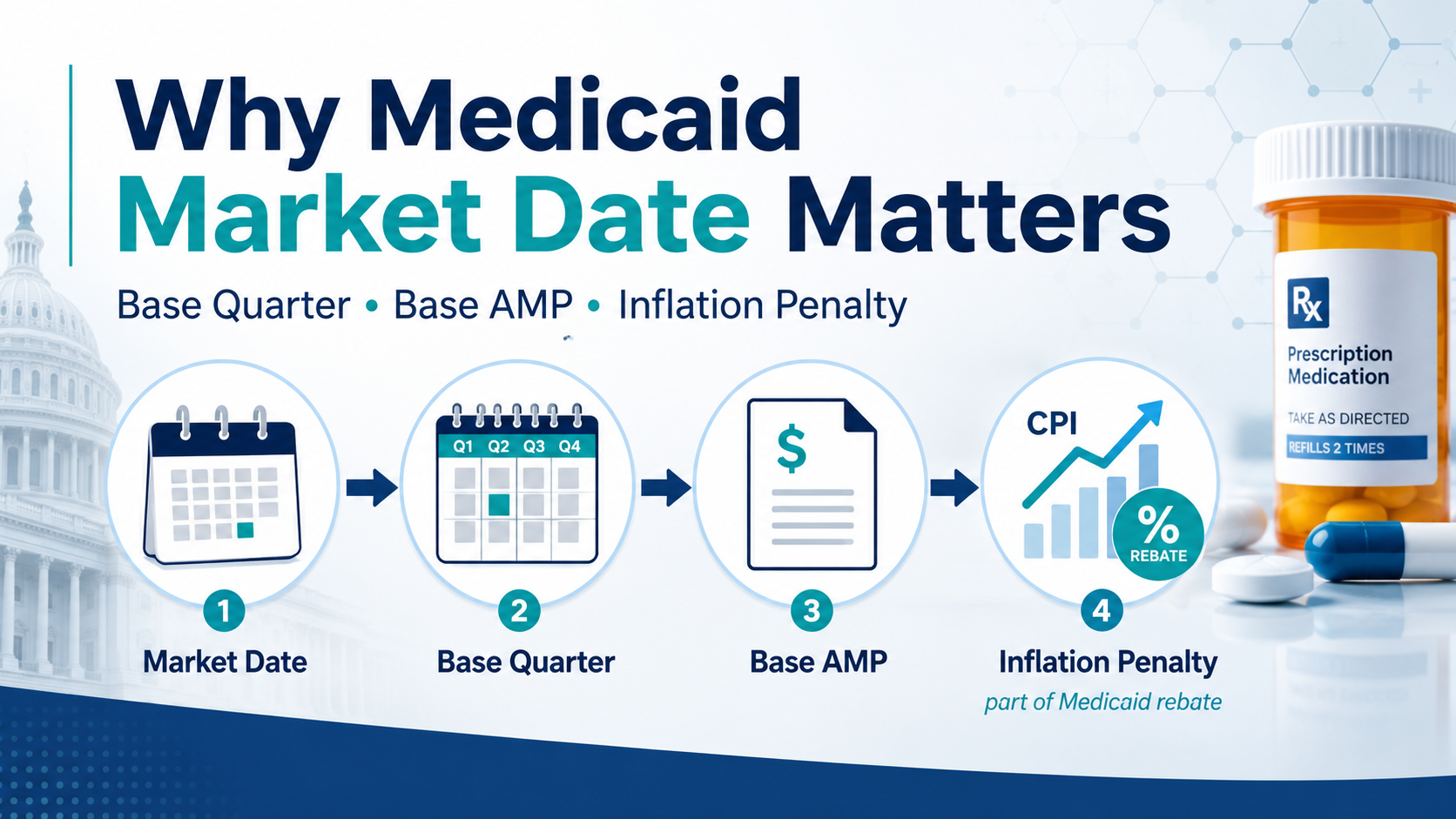
Market Date is one of the most important product data elements in the Medicaid Drug Rebate Program because it determines the drug’s Base Quarter. Base Quarter, in turn, establishes its Base AMP. Base AMP and Base Quarter become a base to calculate the inflation-penalty portion of future Medicaid rebates.
An unusually low Base AMP can materially increase a manufacturer’s Medicaid rebate liability for many years. Except for rare cases of corrections and special situations, Base Quarter and Base AMP cannot be changed.
This article reviews what Market Date is, how it affects the inflation-penalty portion of Medicaid rebates, and what manufacturers should consider when acquiring products or negotiating product launch discounts.
What Is Medicaid Market Date?
According to 42 CFR §447.502 , Market Date is the date on which the covered outpatient drug was first sold by any manufacturer.
The Market Date does not change when the product was acquired by another manufacturer and assigned a different labeler code. Market Date remains the same if the product was discontinued and then re-activated many yearly later. Product Purchase Date does not replace Market Date.
How Medicaid Market Date Affects Medicaid Rebates
Here is overview of the business rules:
- Market Date establishes Base Quarter and a Base Consumer Price Index (Base CPI-U).
- Product AMP, calculated for the Base Quarter, becomes Base AMP
- Inflation-adjusted Base AMP is calculated as Base AMP adjusted for the growth in CPI-U index from Base CPI-U index to the index, applicable to the current quarter.
- The difference between the quarterly AMP and Inflation-adjusted Base AMP becomes the Inflation Penalty.
- The Inflation Penalty is added to the Base Rebate to calculate the total Medicaid Rebate Unit Rebate Amount (URA).
Base Quarter
The rule to establish Based Quarter depends on the Medicaid Product Category.
For single-source (S) and innovator multiple-source (I) drugs, the Base AMP is the AMP for the first full calendar quarter after the Market Date. For Non-innovator generic drugs (N), marketed after April 1, 2013, the Base Quarter is the fifth full calendar quarter after the Market Date.
For references, please see Unit Rebate Amount Calculation for Single Source or Innovator Multiple Source Drugs and Manufacturer Release No. 101.
A full calendar quarter must begin after the Market Date. If the Market Date falls on the first date of the quarter, it makes the quarter not full.
For example, Market Date of April 1, 2026 for of a generic product means that the Base Quarter for that product will be 2027Q3. By comparison, a Market Date of March 31, 2026 will result in a Base Quarter of 2027Q2.
Base CPI-U Index
A choice of the month to clock CPI-U index also depends on the Medicaid Product Category. For S and I products it is the month immediately prior to the first month of the Base Quarter. For N products, it is the last month of the Base Quarter.
CMS web site provides CPI-U values for all relevant history. However, CMS site requires an elaborate authentication, and automated tools may have difficulties accessing it. Another source for CPI-U values is an official site of U.S. Bureau of Labor and Statistics. That site can be accessed without issues. However, for a number of historical months, U.S. Bureau site showed different values, than CMS. At the time of writing this article, Bureau’s web site still shows “-(X)” for an index for October 2025. CMS web site has an actual value for that month.
Knowing the product Market Date, CMS also determines the Base Quarter and the Base AMP, and displays them on the product info screen. CMS also calculates the Inflation Penalty and the Unit Rebate Amount (URA), and uses them when submitting quarterly URAs to the states.
For an additional review of Inflation Penalty see Medicaid Inflation Penalty.
Base Quarter Considerations
The first thing to remember about the Base Quarter is that it does not change. Thus, the timing of the product first sale, which establishes the Market Date, should be chosen carefully.
Before buying a product developed by another company, manufacturer has to find out its Base Quarter and Base AMP. If Base AMP is too low, there might be no chance of selling this product profitably to Medicaid.
Another aspect of Base Quarter relates to one-time Buy-In discounts, often requested by wholesalers for new products. Such Buy-Ins are commercial price concessions, reflected in AMP. If these Buy-In discounts are significant and fall within the Base Quarter, the Base AMP will end up at a lower value. With low Base AMP, Medicaid Rebates will end up higher than expected.
Conclusion
Base Quarter is one of the most important historical data elements in Medicaid Government Pricing.
It establishes the Base Date AMP, which determines if future AMP increases exceed inflation. An unusually low Base Date AMP can create significant long-term Medicaid rebate exposure.
Manufacturers should evaluate the Market Date and Base Quarter during product setup, and product-acquisition due diligence.
Companies offering both brand and generic products should consider both Base Quarter rules and reflect them in agreements with wholesalers, when specifying the timing of buy-in discounts.
This post does not intend to cover all product types and situations.
Learn More
Relasoft Pharma Suite software offers drug manufacturers a sophisticated software platform, which automates Government Pricing calculation and many steps of Medicaid state invoice processing.
For a full overview of Relasoft’s Pharma Suite, visit: https://relasoft.net/pharma-suite/ or contact us at 727-306-1868 to learn how we can automate your GP reporting and processing.